Why I Act Differently: Stigmergy
Two years ago, I stumbled across a book that changed the way I think. "Binding Chaos" by Heather Marsh. In it, she describes a principle so simple it sounds almost ridiculous, and yet so powerful that it has completely transformed the way I work.
Binding Chaos: Listen to a Summary
An audio summary of Heather Marsh's book on radical transparency and the end of oligarchy.
The principle is called Stigmergy.
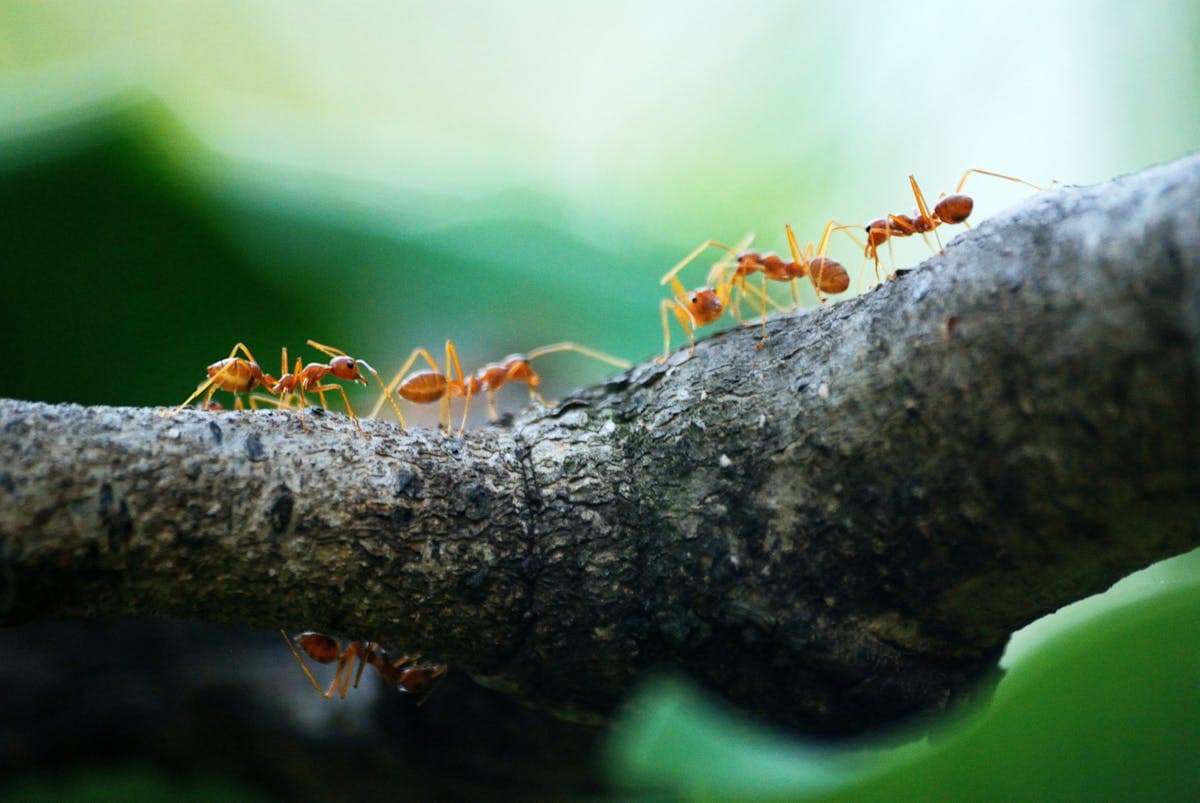
How Ants Build Highways
Imagine an ant colony. Thousands of individuals collectively building complex structures: tunnels, bridges, storage chambers. Without architects. Without blueprints. Without a boss.
How does it work?
An ant carries a grain of sand from A to B. Along the way, it leaves a pheromone trail. The next ant smells the trail and thinks, to the extent ants think, "Ah, something's being built here" and places its grain of sand next to it. The third ant sees two grains and thinks "Something's taking shape here" and continues.
Nobody coordinates. Nobody plans. The environment itself is the communication. Every action leaves a trace. Every trace invites the next action.
That's stigmergy: Coordination through traces in the work, not through communication between actors.
Why Our Systems Don't Work
Now compare that to how humans typically collaborate.
Hierarchy: A boss decides, everyone else executes. Works for simple, repeatable tasks. Fails at everything requiring creativity, adaptability, or distributed knowledge. The boss can't know everything. And when they're wrong, the entire organisation is wrong.
Consensus: Everyone decides together. Sounds democratic. In practice, it means: endless meetings, watered-down compromises, and in the end the person with the loudest voice or the greatest endurance wins. I've sat through enough faculty meetings to know how that ends.
Stigmergy: Someone does something. Others see the result and build on it, or they don't. No meeting. No vote. The result decides.
An Example from My Teaching
I build MCP servers. These are tools that allow an AI to communicate with my systems: Moodle, WordPress, email. When I had built the first server, something unexpected happened.
I didn't present it at a meeting. I didn't write a concept paper. I simply built it and used it. The results (automatically created courses, personalised quizzes, worksheets at the push of a button) were visible.
Colleagues asked: "How did you do that?" Not because I had presented it to them. But because they saw the traces.
That's stigmergy. I didn't try to convince the faculty. I acted, and the result spoke for itself. Some ignored it. Some picked it up. Nobody had to be convinced; the work did the convincing.
Four Advantages of Stigmergy
1. No Permission Bottleneck
In hierarchical systems, you have to ask before you're allowed to act. In consensus systems, you have to convince everyone. Both cost time, energy, and kill initiative.
Stigmergy has no permission problem. You just do it. If it's good, others join in. If not, it quietly dies.
2. The Best Ideas Win
In meetings, it's not the best idea that wins. It's the idea of the person with the highest status, the loudest voice, or the best rhetoric. In stigmergic systems, the idea that works wins. The result is the only judge.
3. Scaling Without Coordination
Wikipedia works this way. Open source works this way. Someone writes code. Someone else builds on it. Nobody coordinates the whole thing, and yet an operating system emerges that powers the world.
Hierarchy doesn't scale beyond a few hundred people without becoming bureaucratic. Stigmergy scales to millions.
4. Resilience
When the boss is absent, the hierarchy grinds to a halt. When the facilitator is sick, the meeting is cancelled. In stigmergic systems, every actor is independent. The system keeps working, no matter who drops out.
Limitations
Stigmergy is no panacea. There are situations where hierarchy works better: crisis management, for example, when fast, coordinated decisions are needed. And there are situations where consensus is important: when decisions affect everyone and require legitimacy.
Stigmergy works best for creative work: when the goal is clear but the path isn't. When many different approaches are possible. When speed matters more than perfection.
It works poorly when standardisation is needed. When everyone has to do the same thing. When deviation is dangerous.
Fortunately, we live in a world where creative work is becoming ever more important and standardised work is being taken over by machines.
The Bigger Picture
Stigmergy isn't just a productivity hack. It's a worldview.
Most societal problems remain unsolved because we're waiting for the right plan. The right policy. The right consensus. We sit in committees and debate while the world burns.
What if instead everyone simply started? In their own place, with their own means, on the problems they can see?
Sounds naive? Open source built an operating system that way. Wikipedia wrote an encyclopaedia that way. The guerrilla gardening movement greened cities that way.
The most successful movements in history weren't centrally coordinated. They were stigmergic. Someone started. Others saw the traces and kept going.
My Call to Action
For four years I was a teacher trying to change the system from within. Through proposals. Through concepts. Through discussions at meetings.
Then I stopped debating and started building. Not with permission. Not with consensus. Just like that.
The MCP servers, the automations, the learning modules: none of it was decided at a meeting. It was all simply done. And it was all picked up because it worked.
The world needs more doers and fewer voters.
Not because democracy is bad. But because action communicates faster than talk. Because results are more convincing than arguments. Because a working prototype moves more than a hundred PowerPoint slides.
So: what do you see that could be better? Start. Not tomorrow. Not after the next meeting. Now.
The ants don't ask for permission either.
Related Articles

January 3, 2026
Planting flowers without asking permission. Guerilla gardening as stigmergy in action.

Die Schulzentrale kündigt TaskCards. Ich baue in fünf Tagen eine barrierefreie, self-hostbare Alternative, zeige sie, und sie nehmen trotzdem das Original. Über den Macher-Reflex, seine Grenze und eine Schranke, die gerade verschwindet.
May 10, 2026
Drei Tage Reflexion über das, was zwischen mir und meinem KI-Setup tatsächlich passiert. Vom Wald in Mitteleuropa über Mykorrhiza-Netzwerke zu MCPs und Skills: warum mein Setup Waldboden ist, nicht Saatgut.